
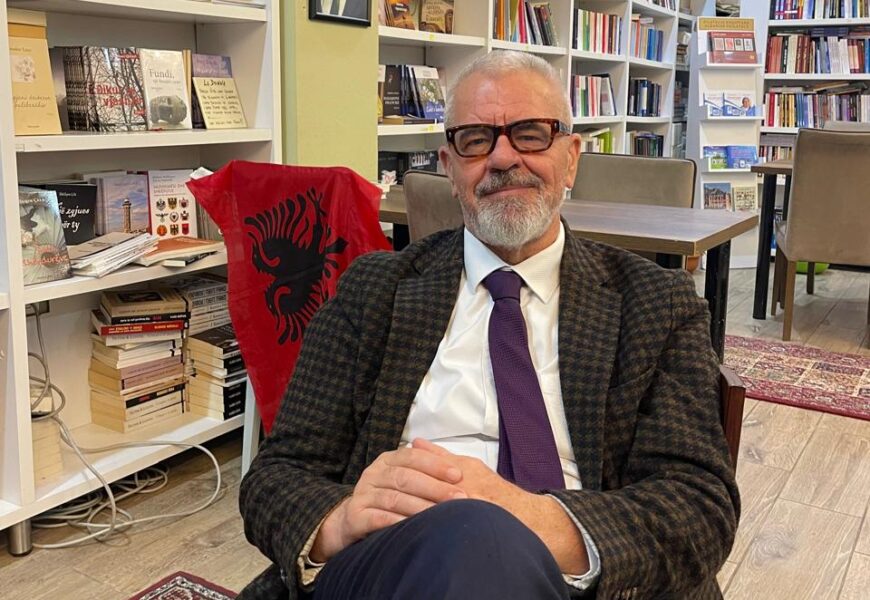
By Albert Rakipi, PhD
1
The republication in Albanian of the book on King Zog and the kingdom he founded and ruled comes more than a quarter of a century after its original publication.
Today, it is difficult to find a copy of the first Albanian edition of this book, published by “Çabej” Publishing House. At first glance, this may seem merely a physical absence. Yet it is a gap that needs to be filled, particularly when it comes to serious scholarly works on the history of our country and our nation.
The importance of Bernd Fischer’s book extends beyond the historical reassessment of a king and his reign. It concerns one of the most consequential processes in Albania’s modern history: the establishment and consolidation of the institutions of the modern Albanian state. It also raises a question that Albanian society and its academic community have yet to confront adequately: how can the history of a nation and its state be understood when entire historical periods have been interpreted, distorted, or even erased through the ideological narratives of a totalitarian regime?
This question becomes particularly important when history has been politicized to the extreme in order to glorify another political history—that of the communist regime—which was presented as the most important chapter in the history of the nation and the state. According to the narrative of the communist dictatorship, the nation, and especially the state, began with communism and Enver Hoxha, in contrast to the “traitors” such as King Zog and all those others who, according to official propaganda, had “destroyed, impoverished, and sold Albania.”
Thus, the absence of the book about King Zog is not simply a physical absence. Thirty-five years after the fall of communism, there has still been no sufficiently comprehensive and critical reassessment of Albania’s modern history, while important elements of communist historiography remain largely unchallenged. They continue to influence public perceptions of the past, including among younger generations born after the collapse of the communist regime.
The first reason for republishing Fischer’s book on the Kingdom and the modern King of Albania is therefore to give a new generation of Albanians another opportunity to learn the history of their own state and country, the history of both the state and the nation. Perhaps bringing this historical work back into public attention may encourage reflection, first within Albanian society, but also in the academic community, on the need for a serious reassessment of the past and for independent scholarly contributions to the study of history.
2
When Bernd Fischer’s King Zog and the Struggle for Stability in Albania was published in Albanian almost thirty years ago, I must say that I had three distinct reasons for wanting to read it. The book about “King Zog,” which was also a book about one of the most important periods in Albania’s modern history, had been published in the West in 1984. Yet it had never managed to cross the Iron Curtain of Albania’s extreme isolation—political, intellectual, or otherwise. Until 1990, Albania remained one of the last bastions of Stalinism in the world.
First, I had an extraordinary and very personal curiosity to read the “book about King Zog.” My initial interest was connected to my family—particularly to my mother, but above all to her father, my grandfather, an employee of “Zog’s anti-people regime,” although in reality he was a civil servant of no particularly high rank.
For a long time, my maternal grandfather had been the “black mark on my political biography” under communism. Even my classmates and friends at the Xhafer Tefiku eight-year school in Barmash, Kolonjë, although they were very fond of me, knew that I came from a “declassed” family and that they had to be careful in expressing their affection and respect for me.
Until 1990, my grandfather—the civil servant of “Zog’s despotic regime”—followed me throughout my life with an unspoken love, very much like that of my late mother. Tragically, however, he was also a political burden, utterly incomprehensible and impossible to overcome, affecting my education, employment, and career under communism.
So when I received an invitation to attend the presentation of King Zog and the Struggle for Stability in Albania, I felt both joy and a deep emotional tremor. It was like being reunited with my grandfather, whom I still remember vividly, although I was no more than five or six years old when he “waved goodbye to all of us and departed.” My first interest was to learn about the “anti-people regime,” the regime of “the despot Zog,” for which my grandfather had worked and which had become an enigma to me.
My second interest was simply the curiosity of any Albanian wishing to learn the history of his country, particularly a history that had been portrayed as one of the darkest periods in the country’s past. And last, but certainly not least, I had a particular academic interest as a student of international relations and history. International relations, history, and foreign policy were my new intellectual passions at the time, and they remain so today, more than three decades later.
As I had expected, Bernd Fischer’s book about King Zog overturned the official narratives of the communist regime, as well as communist historiography’s portrayal of “Zog’s bloody regime.” At the same time, it was a form of “rehabilitation” for my late grandfather, but also a shock and a source of bewilderment for many of my students of history and international relations.
They remained just as indoctrinated by the communist narrative about “Zog’s anti-people regime” as their parents, who, although they had never lived a single day under the King’s rule, continued to believe in Albania’s “legendary” and “unique” history, according to which the Zog period had been the most backward, least developed, poorest, and most ignorant period of all, and, of course, a regime directed against the people.
From another perspective, the publication in Albanian of Bernd Fischer’s book about King Zog and the political Albania he led was a slap in the face of the subservient historiography of the communist period, which, under the regime’s terror, had sacrificed the fundamental academic principles of writing and interpreting history.
As Bernd Fischer himself would later put it, “Albanian historians simply amplified Enver Hoxha’s slanders against King Zog and his government.” And perhaps he is right when he suggests that, had historians under communism refused to do so, they would simply have become victims of the communist regime themselves.
For anyone who lived in communist Albania, Fischer’s argument is entirely credible. Historians who had dared to tell the truth about Albania under King Zog—about his life and government, his ideas, and his vision for state-building—could have faced severe consequences. And because they might have become victims themselves, Fischer suggests, we cannot simply condemn them.
There is, however, an important distinction between understanding the circumstances under which historians worked during the dictatorship and accepting the continued reproduction of their ideological narratives after the dictatorship’s collapse. Fear and coercion may explain the intellectual compromises of the past. They cannot justify the absence of critical reassessment in a society that has regained its freedom.
Nevertheless, we all bear a degree of responsibility for confronting the totalitarian culture created under communism. Rewriting history through books and publications liberated from ideological control is indispensable—not only to understand and respect the history of our country, state, and nation, and those who contributed to building them, but also to overcome the legacy of that totalitarian culture. More than three decades after the fall of the oppressive regime, elements of this legacy remain alive and continue to constitute obstacles to modernization, freedom, and development.
It was therefore natural to expect, after the fall of communism, a profound process of reflection throughout society and, in particular, within the academic community—among historians and scholars. Such reflection should have involved revisiting the “truths they had written and published under the iron rule of the regime,” when, in fact, the truth had not merely been concealed but deliberately manipulated.
This applies to the entire modern history of Albania, beginning with the period of King Zog’s rule, continuing through the Second World War, and extending to the supposedly “glorious period” of Enver Hoxha’s Albania. Yet the reassessment that might reasonably have been expected has remained limited and incomplete.
Thirty-five years after the fall of the communist regime, Albanian historiography has yet to produce a sufficiently comprehensive, independent, and critical reinterpretation of the monarchy and its role in the formation of the modern Albanian state.
Unfortunately, there has also been little serious effort to reconsider and modernize the treatment of this period in history curricula at different levels of Albanian education, including universities. When a young academic, a member of the Albanian Academy of Sciences, proposed issuing a postage stamp bearing King Zog’s name and portrait, the proposal to honor the King was promptly thrown into the Academy’s nearest wastebasket.
The period of King Zog’s rule is a pivotal chapter in the modern history of the Albanian state and nation. A serious reassessment of such a foundational period is of particular importance, and a book by a talented and authoritative historian such as Bernd Fischer offered an excellent opportunity.
Yet Fischer’s book was largely “rejected” by sections of the “intellectual elite of postcommunist Albania,” which, unfortunately, at times resembled, like two drops of water, the “revolutionary intelligentsia,” as Enver Hoxha and his propaganda institutions used to call it.
Instead of becoming part of the curricula of history departments at Albanian universities, the book was largely marginalized. One reason was undoubtedly communist indoctrination and the continued influence of the communist narrative long after the regime’s collapse. But another reason, neither insignificant nor easily overcome, was connected to Albania’s academic hierarchy: many Albanian historians and academics had built their careers and risen through the ranks of academia by propagating an ideologically distorted history of Albania under King Zog.
Reconsidering that history would therefore require more than revising the interpretation of a particular period. It would also mean questioning the intellectual foundations upon which parts of the country’s academic establishment had built their authority.
3
Ismail Kadare has a story, as simple as it is extraordinary, entitled The Time of Writings, in which, through a particular context and a single detail, one can grasp the unimaginable extent of indoctrination under communism when it came to King Zog and his rule.
Vehap, a teacher of botany and history, was in the habit of asking his students to connect their history lessons with the present. And this customary request by Professor Vehap was intended to draw a sharp contrast between the history of Albania’s earlier periods—inevitably the “dark periods”—and the “bright” history of Socialist Albania under communism.
It is both comic and tragic when Genci, who had already received a failing grade in mathematics, is called upon in botany class by Professor Vehap to explain the assimilation of chlorophyll. Being utterly unprepared, “as clueless as could be,” as Kadare puts it, Genci expected Vehap to ask him to connect the subject of chlorophyll assimilation with the present day. And since Professor Vehap did not do so, his pupil decided to make the connection himself, linking chlorophyll assimilation “with the past and the present,” and declaring with a sense of triumph:
“Under Zog’s anti-people regime, no attention whatsoever was paid to the assimilation of chlorophyll.”
Of course, this was also Kadare’s way of mocking the regime. The year was 1984, and Hoxha was still alive. Nevertheless, the story managed to pass through the regime’s vigilant filters and censorship. It was published before the novella A Moonlit Night, which was subjected to discreet criticism, once again making the writer a target.
But beyond Kadare’s sarcasm, this story illustrates with extraordinary clarity the frightening extent of indoctrination. And we, the “contemporaries” of Genci, the story’s protagonist, are all witnesses to that extreme indoctrination.
But not only us. At least three generations, since the communists and Enver Hoxha came to power, witnessed an aggressive and multifaceted propaganda campaign aimed at discrediting, belittling, and condemning Albania’s earlier history and its leading figures, including King Zog and his contribution to laying the foundations of a modern state—I must repeat, of modern Albania.
Hoxha and the communists constructed their own legend, and their coming to power marked year zero for the state, the nation, and the homeland. Everyone who had come before them was declared ignorant, antidemocratic, an oppressor of the people, and, of course, a traitor to the homeland.
We all remember the oppressive, almost daily narrative of the regime, according to which the “outstanding achievements of Socialist Albania” were compared with the year 1938—that is, with “Zog’s backward regime.” It is precisely in this systematic rewriting of the past that we must look for an explanation of why Enver Hoxha’s narrative about King Zog has proved so persistent, continuing to influence perceptions even among younger generations.
Historian Bernd Fischer, the author of this book, wrote in September 2025 that he was deeply surprised by the fact “that so many people in Albania, even among the younger generation, have a negative opinion of King Zog, or at least know very little about him.”
A historian such as Fischer, who has devoted his academic life to Albania and has produced several outstanding works on our history over the past hundred years, also has an explanation for this. Enver Hoxha’s lies and defamatory myths about King Zog, propagated by his regime, amounted to a profound process of indoctrination. The negative narrative was disseminated through schools and every form of media, not only in historical accounts but also in literature, the arts, and films.
But there are, of course, other reasons why this totalitarian culture and the communist narrative about Zog and the years of his rule remain alive. First, it would not be inaccurate to say that there is a lack of willingness to confront the past—if the situation is not, in fact, worse than that. One need only consider, for example, the proposal made in Parliament in 2025 to honor Enver Hoxha. Was this merely an accident?
The shortage of serious scholarly studies, documentary works, and critical interpretations of different periods of Albania’s modern history has contributed to the survival of old myths. In the case of King Zog, Fischer’s work remains among the most important scholarly contributions. More regrettably, some interpretations continue to reproduce elements of the communist narrative, including within sections of the Albanian academic community, both inside and outside the country.
The lies, slanders, and demonization of the King—for example, that “the King stole the gold,” “fled Albania,” “did not fire a single shot against the fascist invaders,” and “stole the state treasury and escaped”—are among the accusations that continue to circulate.
An Albanian author whose book was published in the West provides an illustration of the persistence of these narratives. While in the first part of the book the author’s teacher represents the official communist narrative about Zog—“who stole the state treasury and fled”—in the final part of this book, something between an essay and a diary, the author herself repeats the same interpretation of the Kingdom and the King, writing:
“Prince Leka’s electoral campaign in 1997 appears to be very well funded, and surely the money came from what King Zog stole from the Albanians on the day he fled the country in April 1939.”
If, under communism, it was impossible to consult all the documents, and historians and political scientists of the time were obliged to follow the official version of history, today there is no justification for repeating such accusations without examining the historical evidence.
For example, today’s academics could consult another document: the testimony of the U.S. ambassador in Tirana, reproduced in a book by Ilir Ikonomi published by the Albanian Institute for International Studies. The former ambassador writes that he was summoned to a private audience with King Zog two days before the Italian invasion and that the King, with tears in his eyes, asked him to tell the President of the United States to save Albania—and that “only the United States could do so.”
The accusation that Zog fled without offering any resistance to the invaders also deserves a more serious historical examination, rather than the repetition of a politically convenient narrative.
During the Second World War, several European monarchs and royal families chose exile following the occupation of their countries. Their departures did not necessarily signify the abandonment of their nations. In a number of cases, exile provided a means of maintaining political representation, legal continuity, and resistance to foreign occupation.
The circumstances were not identical, and the choices of European monarchs varied. Nevertheless, the experiences of the Norwegian, Dutch, Greek, and Yugoslav monarchies demonstrate that departure from an occupied country could also be understood within the framework of preserving the continuity of the state.
In April 1939, when Fascist Italy invaded Albania, King Zog I refused to sign a surrender and left the country with his family and part of his government. He never formally abdicated and continued to regard himself as the legitimate head of the Albanian state in exile. He sought support in Greece, Turkey, France, Britain, and Egypt for the organization of Albanian resistance, although the international circumstances and the political constraints he faced prevented these efforts from producing the results he sought.
Whether his decisions were the most effective or appropriate under the circumstances is a legitimate question for historians. But that question cannot be answered through the simplistic formulas of communist propaganda.
The historical assessment of King Zog, including his departure in April 1939, requires an examination of the political, military, and diplomatic circumstances of the time. Only such an approach can distinguish historical responsibility from political mythology.
4
For a long time, I have believed that the title King Zog and the Struggle for Stability in Albania is somewhat too narrow for a book that describes, analyzes, and documents, through a critical approach, the process of building the modern Albanian state.
This was how I understood the book from my very first reading, and it is how I have discussed it with the author whenever we have spoken about this historical period and the role of King Zog.
With this idea in mind, I proposed to Bernd Fischer the republication in Albanian of his 1984 book, also as a way of addressing the need to understand the first steps—or, in fact, the very foundations—of the modern Albanian state.
It is the same book, but with a new preface by the author, in which, among other things, he emphasizes precisely the King’s role in laying the foundations of the state. Perhaps this may also serve as an appeal to everyone in Albania to reflect on history and to give due recognition to all those who contributed—and to the ways in which they contributed—to the making of Albania.
The title is new as well. King Zog and the Foundations of Modern Albania is, in fact, the result of a “three-way consultation”: between Bernd Fischer, as the author; Ilir Ikonomi, a historian who, with admirable academic integrity, has produced monographs on the King’s rivals and opponents, such as Konica and Noli; and myself, whose passion for research on state-building has yet to diminish. This consultation took place at the Tirana Times Bookstore during the third week of October 2025.
I wish to emphasize that these notes accompanying the new edition of this book are not intended to idealize or glorify King Zog’s role in Albania’s history. Rather, they are intended to invite readers, scholars, and students of history and international relations to read Fischer’s book about the “King” from the perspective of the formation of the modern Albanian state.
Following the declaration of independence in 1912, Albania was, in the most basic sense of the term, “a state without a state”: without a consolidated administration, without an effective national army, without established public finances, without effective control over its territory, and with its international status and borders still subject to the decisions and rivalries of the great powers. These were fundamental conditions for the existence and functioning of a sovereign state.
In this context, Zog, beginning in 1920 and subsequently as prime minister, president, and later King of the Albanians (1928–1939), played a central role in building and consolidating the institutions of the Albanian state. In a country still characterized by powerful tribal structures, regional divisions, weak institutions, and competing political loyalties, he sought to establish a functioning central authority and transform Albania into a modern state.
Under his rule, the administration, army, judicial and financial systems were reorganized and consolidated. A national currency was established, and the Constitution of 1928 introduced a new institutional framework for the monarchy, drawing on European constitutional models. The Albanian state acquired a greater degree of administrative cohesion, political stability, and the capacity to exercise its authority throughout the country.
Zog’s reforms in education, justice, the economy, and culture contributed to the foundations of Albanian modernity. Schools were opened, the National Bank was established, laws were codified, and the civil administration was strengthened. His efforts to affirm Albania’s sovereignty, maintain a diplomatic balance among the powers of the time, and bring the country closer to Europe formed an important part of this process.
None of this means that the political system established by Zog was democratic, or that the modernization of the Albanian state was free of serious limitations and contradictions. His rule was authoritarian, political competition was restricted, and Albania’s growing financial and political dependence on Fascist Italy ultimately placed severe constraints on the country’s sovereignty.
But the authoritarian character of a political regime and its contribution to state-building are not necessarily mutually exclusive. The establishment of institutions, the consolidation of state authority, and the modernization of public administration must be distinguished analytically from the democratization of political life. A serious historical assessment requires that both dimensions be examined, rather than allowing one to erase the other.
It is precisely this distinction that makes Fischer’s contribution so important. His book provides an opportunity to examine Zog’s rule not through the ideological categories inherited from communism, nor through an uncritical glorification of the monarchy, but through the political and institutional realities of Albania during one of the most formative periods of its modern history.
Zog was not merely a monarch. He was one of the principal architects of the modern Albanian state, seeking to provide the nation with lasting institutions, political stability, and a European political identity. His achievements, failures, and contradictions belong to the same history and must be examined together.
It is in this sense that King Zog deserves the historical recognition suggested by Bernd Fischer: “The Founding Father of the Modern Albanian State.”
Recognizing this role does not require us to idealize the King or his reign. It requires something much more important: the willingness to confront our history without ideological prejudice, to distinguish the making of the state from the political mythology surrounding it, and to acknowledge the contributions of those who helped build modern Albania, regardless of the regimes that followed them.
Thirty-five years after the fall of communism, this remains not only an academic responsibility, but also an intellectual and civic imperative. A society cannot fully understand the state it has inherited, or the state it wishes to build, without first coming to terms with the history of its creation.